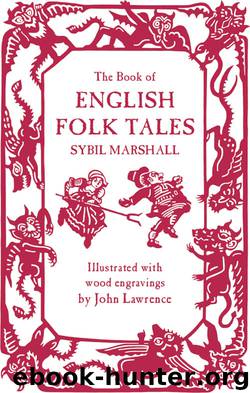
The Book of English Folk Tales by Sybil Marshall
Author:Sybil Marshall [MARSHALL, SYBIL]
Language: eng
Format: epub
Tags: FIC010000: FICTION / Fairy Tales, Folk Tales, Legends & Mythology
ISBN: 9781468315240
Publisher: The Overlook Press
Published: 2016-12-20T05:00:00+00:00
So the head was carried to the chapel, to be interred with the body – when another miracle took place. No sooner had the head been placed with the corpse than it miraculously joined itself on again, leaving no more than a faint red mark to show that it had ever been separated.
From that time on, the tomb of Edmund became a place of pilgrimage, so many were the miracles the dead king performed. At last, in 903, the temptation to appropriate such a splendid relic overcame the Abbot of Beodricsworth. He prepared a wooden shrine for it, and his monks translated it. Thereafter, what had been Beodricsworth became known as St Edmundsbury (or, as we should now say, Bury St Edmunds).
Still the story was not finished. When the Danes raided yet again, the body was taken to London for safety. Brought back again, it was honoured by a stone church to replace the wooden one, and at a still later date Baldwin, the first Norman abbot, built the beautiful one which fell into ruins only at the Dissolution.
In the meantime, however, the saint continued to perform his wonderful deeds, as, for instance, when King Sweyn had sworn to destroy St Edmundsbury and put to death every man, woman and child within the town. With this evil intention he set out from Gainsborough; but on the way, he was suddenly confronted by the ghost of St Edmund, seated on a horse, ‘clothed in full harness, and with a sword in his hands’.
Terror flooded through the Danish king, and he cried aloud for help, but the ghostly martyr-king rode straight at him, bore him down, and thrust the sword right through him. Then the phantom dissolved into thin air, while the flesh and blood king writhed in agony for a few lingering hours, and then died.
So the uncorrupted body of the saint remained to the glory of the monks (and their profit) at St Edmundsbury. It is said that they allowed a woman by the name of Oswin to view the corpse every Maundy Thursday, to comb its hair and trim its nails, both of which continued to grow.
The last to be heard of it is the account given at the end of the thirteenth century by a monk of St Edmundsbury, Jocelyn of Brakeland, who had been born in the town and become an inmate of the abbey.
The abbot of the time was one Sampson, who, on ‘the fourth day of the Festival of St Edmund’ called together a few of his most important brethren and confided to them his overpowering wish to look with his own eyes upon the glorious body of the martyred king. So at midnight, when all the lesser brothers were safely asleep, the little band opened the shrine, and removed the coffin lid. The head was still joined firmly to the body, and rested on a little white pillow, quite unstained. The silken shroud which clothed the body was ‘of wondrous whiteness’, and covered equally white linen bindings.
Download
This site does not store any files on its server. We only index and link to content provided by other sites. Please contact the content providers to delete copyright contents if any and email us, we'll remove relevant links or contents immediately.
Circe by Madeline Miller(8123)
Confessions of an Ugly Stepsister by Gregory Maguire(7874)
A Court of Wings and Ruin by Sarah J. Maas(7809)
Burn for You (Slow Burn Book 1) by J.T. Geissinger(7079)
The Bird and the Sword by Amy Harmon(5341)
A Lesson in Thorns (Thornchapel Book 1) by Sierra Simone(5075)
Into the Drowning Deep by Mira Grant(4473)
Stolen (Alpha's Control Book 1) by Addison Cain(4179)
The Queen and the Cure (The Bird and the Sword Chronicles Book 2) by Amy Harmon(4140)
Mythology by Edith Hamilton(3763)
Pernicious Red (When The Wicked Play Book 1) by Natalie Bennett(3511)
Run Little Wolf (The Forest Pack Series Book 1) by G. Bailey(3507)
The Queen and the Cure by Amy Harmon(3307)
(Maiden Lane #5) Lord of Darkness by Elizabeth Hoyt(3076)
Lost Boy by Christina Henry(3010)
Mythos by Stephen Fry(2860)
The Fairy Queen (The Dark Queens Book 6) by Jovee Winters(2805)
Persephone by Kitty Thomas(2697)
Bunny by Mona Awad(2431)
